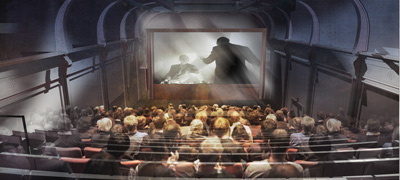
An ambitious project by the University of Westminster to restore the Regent Street Cinema to its former glory and reopen it to the public as a state of the art cinema experience is underway. Situated at the University’s flagship building at 309 Regent Street, London, the cinema is considered to be the birthplace of British cinema having been host to the Lumière brothers’ first ever moving picture show in 1896. The next phase of the University’s fundraising campaign to restore the cinema launches at the venue on March 22nd.
On completion of the fundraising campaign, the Cinema will be restored to its former glory, evoking its 19th century heritage and bringing it right up to date with the latest technology, making it accessible and available to tomorrow’s filmmakers, the film industry and audiences alike. It will reopen in November 2013. Currently used as a lecture theatre, the new Regent Street Cinema will create an outstanding, state-of-the-art cinema and multi-faceted auditorium, a place for academic excellence, for learning, cultural exchange, and exhibitions, and a landmark venue for the British film industry. Film students will showcase their work there and for film lovers it will be a place to see cinema from around the world. In line with the recent government Film Policy Review, this plan reflects a key recommendation for centres that connect arts, culture, education and communities.
Fundraising at the University of Westminster has been led by Sarah Carthew, Director of Marketing, Communications and Development, who says the important project would breathe new life into “the only place in the UK that can genuinely lay claim to being where British cinema started.”
“The re-opened Regent Street Cinema will enable film lovers to come and see films in a cinema that is steeped in cinematic history,” says Sarah. “The Lumière brothers chose the Regent Street Polytechnic (the University of Westminster’s previous incarnation) for their very first screening, because it already had a reputation as a leader in scientific experimentation and entertainment; the Polytechnic was truly a pioneering institution and today the University of Westminster continues to lead the way. The newly opened Cinema will give film students an unrivalled opportunity to premiere their work in London’s West End; we will be able to offer state-of-the-art facilities to local communities and to engage with the UK film industry in a completely new way. “On March 22, I shall be thanking those whose generous contributions mean that a substantial portion of our target has already been met. We are confident that the remaining funds will be raised in time for us to re-open the Cinema in November 2013.”
At the launch guests will hear more about the plans - which include partnership opportunities to secure the rest of the funding - from members of the Cinema Advisory Board including Tim Bevan, Co-Chair of Working Title Films (Tinker, Tailor, Soldier Spy), Paul Trijbits of Ruby Films (Tamara Drewe), cinematographer Seamus McGarvey (We Need to Talk About Kevin) and film composer George Fenton (Looking for Eric). Guests will be able to view architectural plans, a model of the finished cinema and to talk to members of Tim Ronalds Architects whose award-winning portfolio includes the Hackney Empire, Salisbury Arts Centre, The Circus Space in Hoxton, and The Mick Jagger Centre at Dartford Grammar School.
Tim Bevan CBE and Chair of the Regent Street Cinema Advisory Board said: “British filmmaking is unrivalled creatively and technically worldwide thanks to the investment and commitment made by the educational and training world in our talent, and playing a central role in that work is the University of Westminster. Providing students with the facilities to practise and showcase their craft married with the offer of a new cultural centre for the capital is both good commercial and cultural thinking.”
Housed within what was then the Regent Street Polytechnic, the cinema holds a unique place in the history of filmmaking and cinema. It famously hosted the Lumière brothers’ moving picture show in 1896 – the first public cinema performance to a paying audience in the UK. The audience was enthralled, and even slightly alarmed by the reality of the moving image, when they saw ten short films each lasting 50 seconds which then went on to form a sensational worldwide tour to New York, Bombay (now Mumbai), Montreal and Buenos Aires. Restoring the birthplace of British cinema will cost over £5 million. The University of Westminster backed by some of the biggest names in the British film industry, has already received development funds from the Heritage Lottery Fund (HLF) and a ‘green light’ for just under £1m towards the project*. Generous contributions have also been made by the MBI Al Jaber Foundation and the Quintin Hogg Trust meaning a substantial portion of our target has been met. The campaign is now being stepped up to raise the rest of the finance.
Film, photography and early cinematography have always been an important feature in the history of the Polytechnic and the University, from the opening of the first photographic studio in Europe in 1841 and the Lumière brothers’ presentation in 1896, to the winner of the Best Cinematography Oscar™ at the first Academy Awards in 1929, Charles Rosher. Graduates include filmmakers Michael Winterbottom (Jude, 9 Songs, The Killer Inside Me), Asif Kapadia (Senna, The Warrior, Far North), cinematographer Seamus McGarvey (Atonement, We Need To Talk About Kevin, The Avengers), editors Andrew Parker (East Is East, Calendar Girls), Lucia Zucchetti (The Rat Catcher, Merchant Of Venice, The Queen); writers Tony Grisoni (Fear And Loathing In Las Vegas, Red Riding,) and Neal Purvis (Skyfall (Bond 2012), Johnny English Reborn, Let Him Have It,).