The oldest profession?
While it is definitely one of the world’s oldest professions, there is some debate as to whether it is in fact the oldest (what about farmers, hunters, doctors and midwives?). In any case, the sex trade has played a huge part in shaping London throughout the centuries; in The Secret History of Georgian London author Dan Cruickshank states that as many as 1 in 5 women worked as prostitutes in the capital in the 18th century. Up until then Southwark was London’s very own Red Light District, thanks to being located just outside the jurisdiction of the Mayor and being a popular entertainment area due to its many theatres - prostitutes worked within these establishments as well as in a number of whitewashed brothels, catering to gentlemen seeking pleasure on their night out. The spread of syphilis led Henry VII to attempt to shut many brothels down to no avail, and further attempts by his successors couldn’t stop the proliferation of bawdy houses opening in Shoreditch, Clerkenwell, Billingsgate, Smithfield, Westminster, along Petticoat Lane and around St. Paul’s Cathedral. To this day there is little evidence of any male brothels, although one assumes they must have existed, if to a lesser extent.
In the 18th century the trade expanded to the Strand and Covent Garden, where London’s well-to-do gentlemen could pick between upmarket bordellos or encounters of the intimate kind in dark dingy alleyways, depending on their wealth or mood at the time. Covent Garden earned itself the nickname “the great square of Venus” and publications such as The Covent Garden Magazine printed names, addresses, details of physical appearance and the particular specialties of the local ladies. The lists (known as Harris’s Lists, named after their compiler) became so sought after a book was published. The charmer used nautical terminology to describe the women: “loves to fight yard arm and yard arm, and be briskly boarded”, who no doubt delighted in being compared to a ship.
As poverty increased during the Victorian era, many more women were forced into prostitution, and the public’s perception changed from a lightly humorous (if disrespectable) view to one of condemnation and/or pity. The Society for the Suppression of Vice estimated there were some 80,000 women working as prostitutes at the time, mostly around the docks. Soho became a popular spot due to its many public houses, theatres and dance halls and from the 20th century onwards would be crowned as the capital’s centre for sex, a fact which persists albeit in a more sanitised manner, however any establishment displaying a card with the word “Model” is most definitely a walk-up, i.e. an illegal brothel operating on the upstairs of the premises, and the girls are more often than not the victims of trafficking.
\n\nStripping off
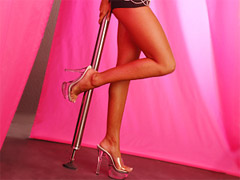
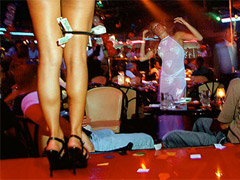
The shows at The Windmill on Great Windmill Street (that’s right, there was once a windmill on the site) first started featuring nude girls in 1932, however it was illegal to have naked women or men moving around on a stage. It was not illegal for them to stand still however, so the girls would pose like statues in front of a mostly-male audience. The venue remained open during the war – one of the few that did - hence becoming a renowned morale-boosting haunt for soldiers, in other words, they could forget about the troubled times by looking at girls standing motionless with their kit off. 1958 saw the opening of Raymond’s Revue Bar, the granddaddy of British strip clubs, as owner Paul Raymond got around the law by declaring the venue a “private club” so that the girls could dance. Despite the odd raid, Raymond was hugely successful, and at the time of his death in 2008 he owned shareholds to half of Soho, including Ronnie Scott’s, Soho House, and incidentally, The Windmill. Peter Stringfellow has no doubt learnt a thing or two from his predecessor, however it’s uncertain why he still thinks sporting a mullet is a good idea.
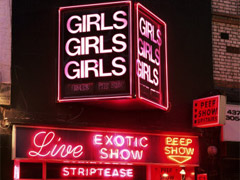
Today The Windmill is still in operation, as is Sunset Strip on Dean Street; there are also a whole host of “clip joints”, where customers can expect to part with large sums of money for watered down drinks and little action other than the menace of a large bouncer, which hardly makes for a sexy outing.
\n\nSex shops and pornography
The increase in the availability of printed material naturally meant pornographic literature would appear in the not too distance future; in the 19th century it could be bought on the streets as easily as a newspaper - particularly on Holywell Street just off the Strand, which later changed its name to Bookseller’s Row to improve its sleazy image - however erotic literature had been around for many years already (Fanny Hill, published in 1748 is widely regarded as the first English piece of prose pornography, although the term didn’t come into being until much later). My Secret Life is the account of a London man and his 1,000+ exploits, published across 11 tomes from 1888 onwards. It is in essence a diary with plenty of crudeness, however it’s a far cry from the pictorials in magazines such as Razzle, Mayfair and Escort, all founded by the aforementioned Paul Raymond.
By the 20th century London’s Red Light area had moved from Southwark and the East End to Soho, and the first sex shops started to appear, particularly from the 1960s onwards. They were hardly legitimate, as shop owners paid police officers bribes to remain open, something which came to light in the mid-80s when a number of officials were prosecuted. Today Harmony and Ann Summers mingle with an abundance of shops displaying coffee table art books in the windows and erotic videos, magazines and toys downstairs – the shops have become as much a tourist attraction as the many cafes and bars that surround them.
Members of the London Feminist Network have started a No More Porn on London Transport campaign, which deems flicking through a lad’s mag whilst on the underground to be antisocial behaviour. Whether The Sun’s Page 3 becomes outlawed on public transport or not, sex will continue to sell till the end of time, regardless of morality campaigns or however many foreign students get fleeced in Soho every year.