When London’s population boomed during the 19th century, the severe overcrowding that ensued extended to the city’s cemeteries. Makeshift graveyards were erected wherever there was an iota of space, illegal burials, which took place without an official member of the clergy present, were not uncommon, and even worse, quicklime was sometimes poured over the dead bodies to help them decompose quicker for the grave to be re-used. In 1832 a law was passed that encouraged new cemeteries to be built outside what was then inner London. Seven graveyards were built since this date, which would later become known as the ‘Magnificent Seven’. Inspired by Père Lachaise in Paris, they were strikingly different to previously constructed burial grounds; in fact their elaborate landscaping made them popular visitor attractions. But that is not to say it was all was afternoon strolls and flower-picking where these new cemeteries were concerned, for unsurprisingly they’ve all had their fair share of grimness…
Tower Hamlets Cemetery
It’s been closed for burials since 1966, and today its purpose is as a conservation park where guided tours take place. Despite recently cleaning up its image, superstitious minds might want to steer clear of the vicinity of Tower Hamlets Cemetery. It is estimated there are around 270,000 bodies buried amongst its 29 acres; furthermore, since it opened in 1841 many individuals unrelated to each other were buried in open graves as their families couldn’t afford a plot of their own. This was Victorian-era East London after all, where some of the poorest slums were located. The cemetery was bombed heavily during the Second World War, the damage of which can still be seen today, and after years of neglect the local council took ownership in 1986 and set about regenerating it.
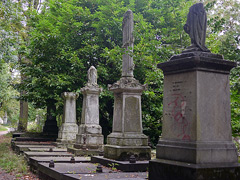
Historical interest: The walls that surround it and 16 of the memorials are Grade II listed. If you’re a nature lover you’ll find sycamore trees covered in ivy (although the ivy is being cleared away to allow more sunlight to reach the ground), primrose and bluebells, as well as 35 different bird species and the odd fox scavenging for food.
Gruesome factor: In 2007 the Daily Mail claimed the local council had decided to dig up hundreds of thousands of graves to make way for Muslim burials. This turned out to not be true.
\n\nHighgate Cemetery
Highgate is supposedly the capital’s most frightening cemetery. It is therefore a popular destination for morbid voyeurs - never mind respecting the dead, Highgate Cemetery may as well be a tour operator, with hourly tours on weekends and bank holidays, concessionary rates and free ice cream (ok, the last bit is an exaggeration). The cemetery was once “fashionable”, if such a term can be applied to a graveyard; where Tower Hamlets was poor, Highgate was wealthy, in part due to its elevated position with panoramic views over North London, encouraging people to build ornate monuments dedicated to their beloved. This would not last however; it fell into decline, eventually closing in 1975. Nowadays it is once again a functioning cemetery, with around 70 burials taking place each year. One of London’s most visited graves, that of Karl Marx, is located here. He lies alongside a large number of intellectuals and artists, including author George Elliot, painter Lucian Freud, ex-Sex Pistols manager Malcolm McLaren and pop artist Patrick Caulfield.
Historical interest: The Egyptian Avenue is a slightly unusual construction which is entered via an arch; its 16 vaults are fitted with 12 coffins. The two chapels, the Church of England and the Dissenters, are housed within a Tudor-style building.
Gruesome factor: The most famous sighting is that of the “Highgate Vampire”, a tall dark figure with a white face which terrorised passers-by in the late 60s, but it moved on along with its other ghostly pals once the cemetery was regenerated.
\n\nKensal Green Cemetery
Kensal Green Cemetery was the first to be opened following the passing of the 1832 Cemeteries Act. It remains one of the most scenic, if a little untidy compared to other cemeteries, with rose gardens, a canal, and more mausoleums than any other London graveyard. Like Tower Hamlets Cemetery, it is also a nature reserve because of the abundance of old chestnut trees and the varieties of birds that inhabit the area. The graves of civil engineer Isambard Kingdom Brunel, inventor Charles Babbage, writer William Makepeace Thackeray, sister-in-law of Charles Dickens Mary Hogarth and numerous aristocrats such as HRH Princess Sophia can be found here. Two-hour tours take place on a Sunday which allow you to explore the catacombs; they’re spookily dark, so take a torch.
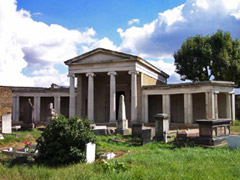
Historical interest: Neo-classical architecture abounds in the form of the Grade I listed Anglican Chapel and the surrounding Colonnade.
Gruesome factor: There isn’t one, as this salubrious cemetery is more of an architectural attraction than a setting for ghost sightings. The degrees of ornateness of the graves do provide a glimpse into the strict class system of the Victorian era however.
Abney Park Cemetery
Abney Park in Stoke Newington lacks the lavishness of the abovementioned cemeteries. Despite the lack of grand mausoleums (or perhaps because of it) it’s one of the eeriest, with a burnt down chapel and visible damage caused by vandalism, making it a popular location for shoots and filming (music videos, BBC documentaries and fashion pictorials for Vogue have been shot here). Ex-servicemen, politicians, and numerous anti-slavery campaigners are interred here.
Historical interest: Architecturally it’s not as interesting as the others, however it is of importance as the 19th century’s main non-denominational burial site. Outdoor lovers will find a wealth of mature trees, flora, and fauna.
Gruesome factor: Goldsmith’s news website East London Lines suggests that Stoke Newington’s hipsters have scared off all the ghosts, which is great news for any atheists needing an exorcism.