If you’re an animal-lover with an interest that extends beyond owning a pet cat, dog or tank filled with terrapins, you can visit London Zoo, Sea Life, Golders Hill Park Zoo and Battersea Park Children’s Zoo. But if you’re the adventurous sort and want to catch a glimpse of an animal going about its business in the wild, you can do so without leaving the M25 - just don’t expect to see a Sumatran tiger.
Bats
There are six different species of bats to be found in Greater London, but the fact that they are nocturnal and small in size makes them hard to spot. Bats (along with their nesting areas) are legally protected – which means it is a crime to harm or disturb a bat – as they are under threat due to the loss of their natural habitat, pesticides, and disturbances like Wi-Fi signals and light pollution. They usually feed on insects (the pipistrelle bat eats up to 3,000 in one night, despite weighing less than five grammes) and fruit, however the increasing use of artificial fertilizers and insecticides means less food. Aside from traipsing around the woods, the best places for you to see bats are Sydenham Hill Woods, Frays Farm Meadows in Hillingdon, Hampstead Heath and Wanstead Park.
Deer
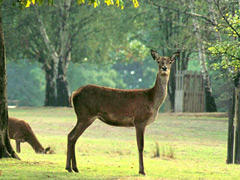
The largest animal you’re likely to find in the wild in London, deer are not confined to Richmond Park. Small muntjac deer in particular are on the increase, and have been seen in woods in Waltham Forest, Tooting and Sydenham Hill Wood. They feed on plants and are discreet, unassuming animals, however some conservationists have expressed concern that they may pose a threat in the future if they start foraging in people’s gardens. It seems like a long way off till that happens however.
\n\nPeregrine Falcons
These powerful birds of prey only really started moving into the urban sprawl in the 90s, possibly due to their penchant for London’s tasty pigeons. They easily make themselves at home at the top of tall buildings like Battersea Power Station, the Tate Modern, and occasionally tower blocks, however peregrine falcons are among the UK’s rarest predatory birds. Peregrine falcons are protected by law as they have traditionally been a prized catch for hunters, but in London the biggest threat is disturbance to their nests (also, during the Second World War they were actively culled to protect carrier pigeons, used by the RAF to transport messages). These super-fast birds dive in on their prey and then either strike them dead immediately or grab them with their claws while still in flight. With a wingspan of up to a metre, they are both majestic and intimidating.
Frogs and Toads
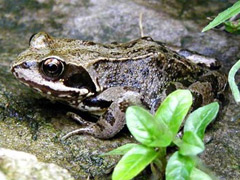
These amphibians are assumed to be common, but when was the last time you saw a toad? As more and more of London’s ponds disappear, so do their inhabitants. Ironically, the increase of people installing ponds in their private gardens may just be what saves them. Frogs and toads are both nocturnal, and can be seen in damp places, near marshes and ponds. Greenwich Peninsula Ecology Park is home to a considerable number of the croaking creatures.
Water Voles
It’s understandable you might not be jumping at the chance to catch sight of a water vole. After all, they look like rats. However, unlike their damnable cousins they feed on plants, and are actually preyed upon by other rodents. Plus they’re furry and round, even cuddly at a pinch. Water voles are not considered a pest, however numbers have dwindled as their natural habitat has been destroyed or altered by humans. They live on river banks and in places with tall grass, therefore destruction of these due to construction work has resulted in a huge loss to the water vole population, pegged at 88% by the London Wildlife Trust. Their waterside burrows are visible at Crane Park Island in Twickenham and Frays Farm Meadows, however you’ll need to be patient as they are notoriously shy. \n\nSwans
Being the property of the Queen has its perks – it means that swans cannot be hunted, cooked and eaten like fellow avians geese and turkeys. They may not be wild technically, their beaks are strong enough to break your arm if you get too close. Suitably regal in appearance they are migratory birds, and several species spend the winter in the UK where it’s warmer than their native Scandinavia. They gracefully swim in London’s lakes, such as the ones at Hyde Park and the Wetland Centre.
Hedgehogs
Once upon a time finding a hedgehog at the bottom of the garden was fairly usual, but gentrification has not been kind to these spiny animals. Epping Forest and Regent’s Park are still home to a few, and if you live in a leafy suburb there is still a chance you might spot one; the best times to look are at night in the spring and summer months as they hibernate. You can also encourage them to pay you a visit by leaving out pet food (although this is also likely attract a whole host of other animals you might not want loitering around) or piling leaves in sheltered areas, as they might decide these are good places to retreat to.
Foxes
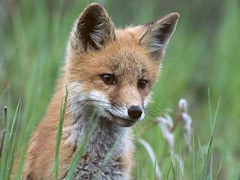
Unlike other wild animals, over the years sightings of foxes in urban areas have increased. Seemingly they’ve become tamer, however in reality they’ve simply adapted well to changing environments to be able to eat – it’s estimated there are 16 foxes per square mile of London. In the countryside they are considered pests as they prey on farm animals, but in the city they are (mostly) allowed to roam free. These nocturnal animals can be seen in pretty much any part of London, and while there is a better chance near wooded areas, it’s not wholly unusual to catch one sauntering down a quiet street in Shoreditch or Camden in the early hours, when they sometimes have the impertinence to make a disturbing wailing sound which can keep you awake for hours.