When I first saw Pre-Raphaelite art I dismissed it as sentimental, chocolate box paintings. Then I studied a little bit of History of Art focusing on the mid-Victorian period and I realised that not only were the artists defiant revolutionaries (in the art world) but critical commentators on society. When you look beyond the painfully intricate work depicting nature in all its vibrant and realistic glory, you learn that each tiny feature contains a message encoded in symbols. Yes, really.
Take “The Hireling Shepherd” by William Holman Hunt for instance. Superficially, a lazy young shepherd is talking to his sweetheart. Yet the straying sheep in the background are a criticism of religious leaders neglecting their flock, and the sourness of the discarded bitten apple and the death’s head moth in his hand tell a different story.
I’ve travelled the country looking at these works – from Birmingham and Manchester to Fulham Palace. So I was excited at the prospect of all the great works being together at Tate Britain.
Origins and Manifesto
Even at the start, the work appears luminous and the attention to detail is amazing –for example, the anatomy in “King Joash shooting the arrow of deliverance” (William Dyce). There’s a scattering of religious images (e.g. “Our Saviour, subject to his parents at Nazareth (the youth of our Lord) John Rogers Herbert). The pointy leg picture (John Everett Millais’ “Isabella”) is based on Keats’ poem about the lover’s head which is severed and placed in a pot of basil (I prefer the Hans Christian Andersen version where it is a pot of jasmine). There are lots of self-portraits here and illustrations. And I rather liked the little black plaster “Puck” (Thomas Woolner) who looked like a creature from a fantasy computer game.
History
The next room has more familiar works. “A wounded Cavalier” by William Shakespeare Burton shows the wounded soldier and a maid illuminated against the dark forest. Hunt’s “Valentine rescuing Sylvia from Proteus” has jewel rich colours and detailed costumes and a posed composition that captures a moment in time. I found “Mariana” (Millais) here – the stained glass windows and embroidery ignored as the woman stands and stretches in her rich blue dress with tiny details like a mouse and dried leaf on the floor.
I remember studying “A Huguenot on St Bartholomew’s Day, refusing to shield himself from danger by wearing the Roman Catholic badge” – the vibrant purple clothes, the brick garden wall, the broken flower at their feet and the look of concerned young love on the woman’s face. There were some marble statues here too and illuminated stained glass windows and early sketches by Elizabeth Eleanor Siddal of “The Lady of Shallott”.
Nature
“The Hireling Shepherd” is here. The rooftop view of Ford Maddox Brown’s “An English Autumn Afternoon, Hampstead” and the William Dyce’s seaside classic “Pegwell Bay, Kent” too. Another of my favourite’s “Ophelia” by Millais is here – and most people know the story of how the poor model had to lie in a bath of water for ages so that the painting was accurate. The detail in the flowers in and around the stream is mind boggling – especially where it becomes hard to tell where her hair and dress end and the water plants start. There is also a rather fine marble statue here of a boy and his dog – a long coated greyhound, whose playful gait is cleverly supported by fern fronds (“Young Romilly” by Alexander Munro).
Salvation
Some interesting works in here as well as some of the most famous like “Work” by Ford Madox Brown, that Christmas card image of Christ at the door with a lamp (“The Light of the World” by Holman Hunt) and the image of a fallen woman in “Found” by Rossetti.
Another of my favourites was here too – “The Awakening Conscience” by Holman Hunt. In the rich reds and greens of an untidy parlour – notice the cat playing with a mouse in the corner as a metaphor for the lover-mistress situation – a young woman suddenly gets up from the lap of her married lover (where they have been playing the piano) in a moment of realisation of the error of her ways. Yes, it’s a cliché but I like the way she’s portrayed looking a bit awkward as she stands – another reflection of her situation.
I remember liking “The Annunciation” by Rossetti when I studied it although religious images aren’t usually my thing – it’s the way Mary looks rather reluctant, the relatively plain and simple room, the lack of wings on the angel and the use of the lilies and doves as symbols of purity and peace.
Beauty
Some lovely paintings here – with those classic Pre-Raphaelite women all voluptuous with flaming red hair – like “Lady Lileth” by Rossetti. “Isabella and the Pot of Basil” by Holman Hunt is huge and impressive and I adored all the detail in the room surrounding the main subject.
Earthly Paradise
This room is a little different as it has carpets, tapestries, beds and other furniture. William Morris features strongly and some of the pieces are stunning (e.g. “Ladies and Animals Sideboard” by popular Edward Burne-Jones).
Mythologies
The pale simplicity of “The Golden Stairs” by Burne-Jones is here and captured my attention for a while. One of my favourites “King Cophetua and the Beggar Maid” by Burne-Jones bought me to a standstill – it’s size takes your breath away and the luminosity of the skin of the maid makes her stand out against the richness of the environment and people around her. Mind you, the reflections on the glass made it hard to see the picture in its entirety so I had to keep altering my position to take in each part of this incredible work. Sorry if I bumped into you as I did so!
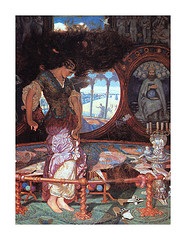
And then a new (for me) discovery – an alternative (most people think of the Waterhouse image of her in a boat) “The Lady of Shalott” by Holman Hunt – she is wild and passionate and her hair is all dramatically all around her as she is caught up in a tangle of wools from her weaving – like a fly trapped in a spider’s web facing its death. It was a suitable climax for my tour of these great works.
www.tate.org.uk The exhibition runs until 13 January 2013