As a child, every Sunday morning I had to listen to my father playing opera on records that he had borrowed from the local lending library. I hated it. Then, about 15 years ago, a boyfriend took me to see an opera in the West End and I was instantly hooked. Ever since, I have been a fan and have seen many operas in many locations. And that music on those Sunday mornings must have been ingrained in my memory. Puccini remains a favourite.
An old friend of mine, who now lives outside London, said that she had never been to the opera and would love to go. I have a strategy when introducing people to the art – first in English, then in Italian and then in Verona! So I booked tickets to see La Boheme at the ENO. It’s expensive (£66 a ticket for seats in the upper circle) but the Coliseum is a truly beautiful venue and it’s not nearly as costly as the Royal Opera House.
So we met at Leicester Square station around 530pm and made our way round the corner to the basement Salvador and Amanda’s for some tapas and wine before the show. This is fabulous place – there’s a special happy hour deal on wine (£10 a bottle) and the food is about as authentic Spanish as you can get. Only a lone padron pepper was left over as testimony to the small feast we enjoyed.
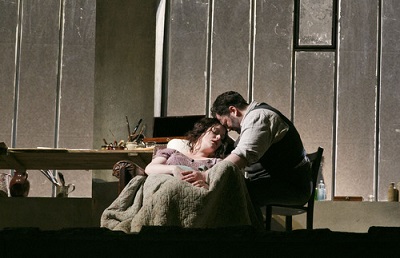
This popular Puccini opera is in four acts. In a nutshell, there’s a group of young men – all artists – who live in poverty in an attic in a wintry and cold Paris. They are behind with their rent and can hardly afford food and fuel even though it is Christmas. Mimi is a young seamstress who lives in a nearby apartment and pops in to ask for her candle to be lit. Rodolfo falls in love with her and they start an affair. A local girl called Musetta struts her stuff and flirts with the men at a local cafe. Mimi breaks up the relationship because Rodolfo is so jealous. Rodolfo admits to his friend that he loves Mimi but realises that she is dying. Musetta brings Mimi back to Rodolfo in her final hours. Much sadness ensues. As is usual in opera.
The scenery was superb. The attic was artful – untidy, bare and with soft light falling through the windows. The stage hands moved the set between acts so that it converted first into an al fresco bar and then into a Parisian suburb, with lifelike snow to good effect. I was shivering but maybe that was the wafts of cool air from the air conditioning.
The street scenes buzzed with people and children making it all feel very real. My friend thought it was amazing – and found the subtitles above the stage helpful for keeping up with the story. She has pledged to go again.
For me, the experience wasn’t quite so magical. Opera in English just doesn’t do it – I found myself singing the Italian in my head. The orchestra seemed quiet too – which reduced the emotional connection a little. It’s fiendishly hard to find someone who can convey the youth and fragility of Mimi whilst also having the skill to sing the dramatic arias. Newcomer Angel Blue, playing Musetta, brought a fresh angle to the role but the stand-out performance from my perspective was that of Gwyn Hughes Jones as Rodolfo.
Opera is rather like marmite. People either love it or they hate it. But I always implore people to try it out by going along – not so much for the storylines but for powerful music and dramatic singing that wraps you up in the moment, evokes strong emotions and often moves people to tears. The ENO can chalk up another convert.